
Article
Why the moment matters more than the footage
A foundational article on why documentation can never fully replace the emotional density of being there.
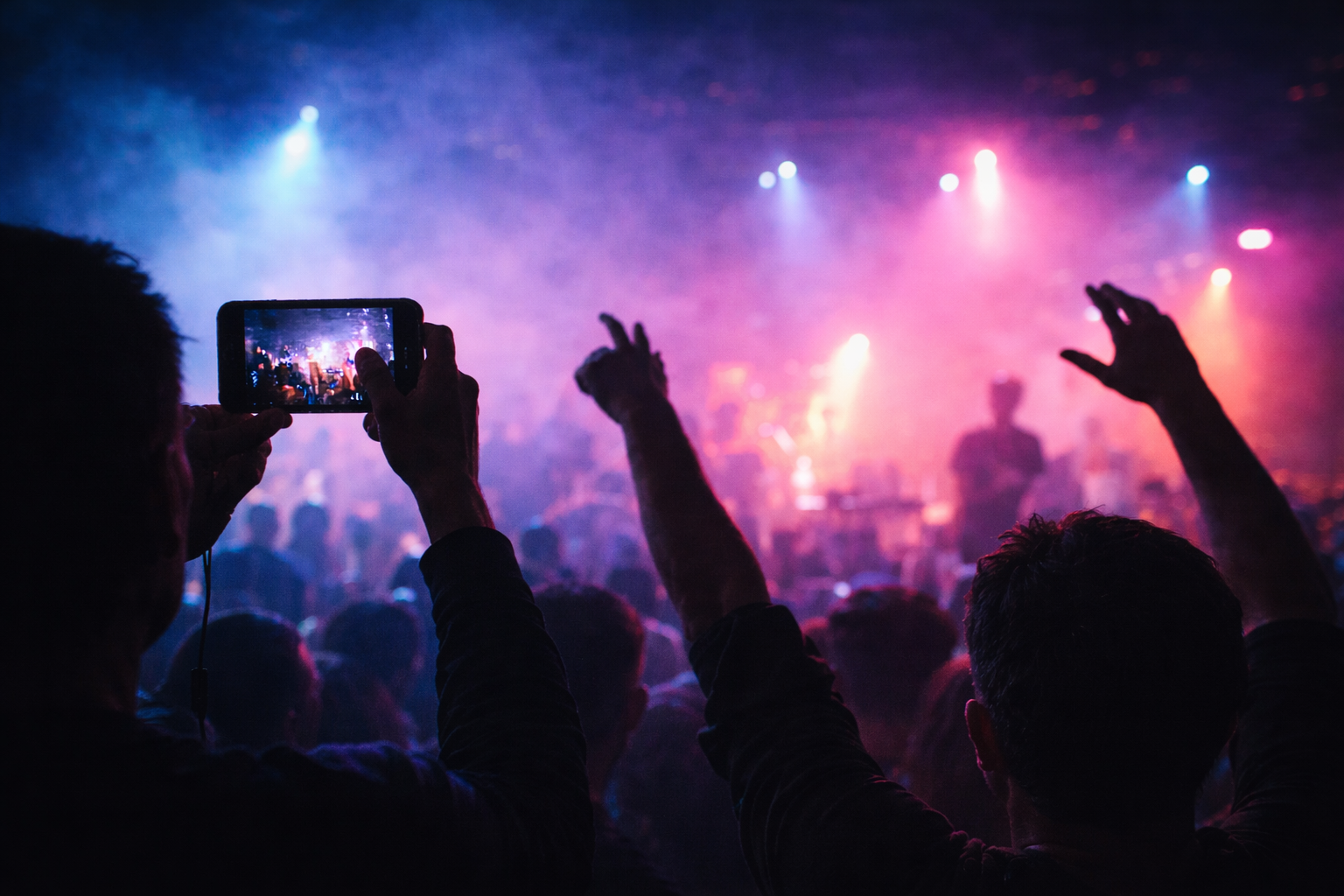
A filmed clip can preserve an angle, a sound, a gesture or a proof that something happened. What it cannot preserve in full is the thickness of presence: the temperature of the room, the anticipation before a drop, the shared reaction of strangers, the physical pressure of sound, the sense that something is unfolding only once and in real time.
This difference matters because the culture around events is increasingly shaped by behaviour that treats the record as equal to the event itself. It is understandable. People want to keep something. They want to share where they were. They want to mark identity and memory. But when the recording becomes the dominant layer of participation, attention fragments.
The loss is subtle at first. The crowd looks present, but the room feels less connected. People are no longer following the same emotional arc. They are splitting themselves between witness and operator. They are there, but also slightly outside the moment, managing a future piece of content.
Presence is not a romantic slogan. It is a condition that changes what an event can become. A more present room often produces stronger feedback for the artist, deeper immersion for the audience and more memorable collective energy overall. It is not about purity. It is about quality.
That is why the conversation is worth having now. Not to shame people for recording, and not to demand impossible rules, but to rebuild a cultural understanding that some moments become more valuable when they are lived more fully than they are captured.